
Author: Melissa Trendt, Licensed Veterinary Technician
Ahh, dog kisses. Either you’re team “yes please,” or “eww.” But when stinky dog breath is involved, everyone’s on the same team. So, what causes stinky dog breath, and how can you help your dog avoid it?
The Root of the Problem
You might be surprised to learn that 80% of dogs over age of three have active dental disease.
Canine dental disease, known in the veterinary world as periodontal disease, happens when bacteria in the mouth work their way into the gums. This leads to inflammation of the gums, damage to the supporting structures and bone, and, ultimately, loss of teeth.
There are four stages of periodontal disease:
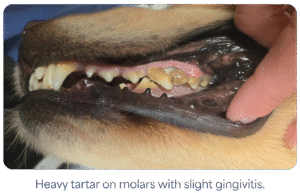
• Stage 1: Gingivitis – inflammation of the gums, marked by redness along the gumline just above the teeth.
• Stage 2: Early periodontitis – this is marked by 25% loss of a tooth’s attachment to its supporting structures.
• Stage 3: Moderate periodontitis – the tooth has lost 25–50% of its attachment.
• Stage 4: Severe periodontitis – over 50% attachment loss and visible gum recession.
Plaque vs. Tartar
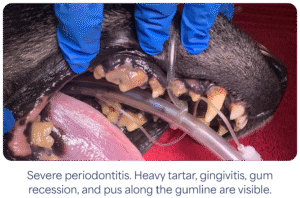
There are two main offenders in the dental world: plaque and tartar.
Plaque is a sticky substance consisting of bacteria that forms daily on the teeth. If it is not removed, it can harden into tartar. As tartar begins to build on the teeth, it can lead to gingivitis and periodontal disease.
Brushing dogs’ teeth removes plaque, which helps prevent the formation of tartar and dental disease. Teeth should be brushed several times a week at least, using a toothbrush and toothpaste made specifically for dogs.
Making Brushing a Positive Experience
Most dogs won’t open up and say “ahh” when presented with a toothbrush, so how do you achieve such a lofty goal?
Start in puppyhood to form a positive association:
-
Begin with a pet finger brush or your finger, with or without toothpaste.
-
Use cheese or peanut butter on the toothbrush to gain interest.
-
Focus on the outer surfaces of the teeth (the ones facing the cheeks).
-
Gradually work up to using a regular toothbrush and toothpaste.
With patience and practice, most dogs tolerate brushing once they get used to it. If your dog isn’t a fan of brushing, PAWS carries a topical gel that can be applied to the teeth to help prevent buildup of plaque and tartar.
Safe Chewing for Healthy Teeth
Much of a puppy raiser’s time is spent removing objects from their puppy’s mouth. Dogs love to chew, and they do it for several reasons. Whether it’s for stress-relief or to help work those baby teeth out, chewing provides stimulation for dogs.
But not all chews are safe. Some can actually break or damage teeth, including:
-
Animal-derived chews (bones, antlers, yak chews, rawhide, cow hooves)
-
Nature-found items (sticks, rocks, and even ice cubes!)
Many commercial chew toys are actually too hard for the teeth. Here’s a quick test: Press your thumbnail into the chew. If you can make a dent, it’s safe for your dog’s teeth.
PAWS recommends:
-
Size-appropriate Kongs
-
Virbac Dental Chews
-
Q-Chef Dental Chews
-
West Paw Zogoflex
-
Clenz-a-Dent Chews
-
Oravet Chews
Unless your dog is on a strict or prescription diet, you can also offer healthy snacks like carrots, green beans, or apple slices to keep their mouth busy.
Fresh Kisses Ahead
Dog breath doesn’t have to stink, and following these tips will help keep those kisses fresh!
BONUS: Canine Teeth Fun Facts!
-
Puppies have 28 baby teeth; adult dogs have 42 teeth.
-
There are four types of teeth: incisors (cutting), canines (tearing), premolars (grinding), and molars (crushing).
-
Puppies start losing baby teeth around four months old and usually have all their adult teeth by six months.
-
Small-breed dogs are more prone to developing periodontal disease.
-
Dogs require regular dental cleanings—just like humans!
-
Periodontal disease can lead to damage of the heart, liver, and kidney if bacteria enter the bloodstream.